Hey readers,
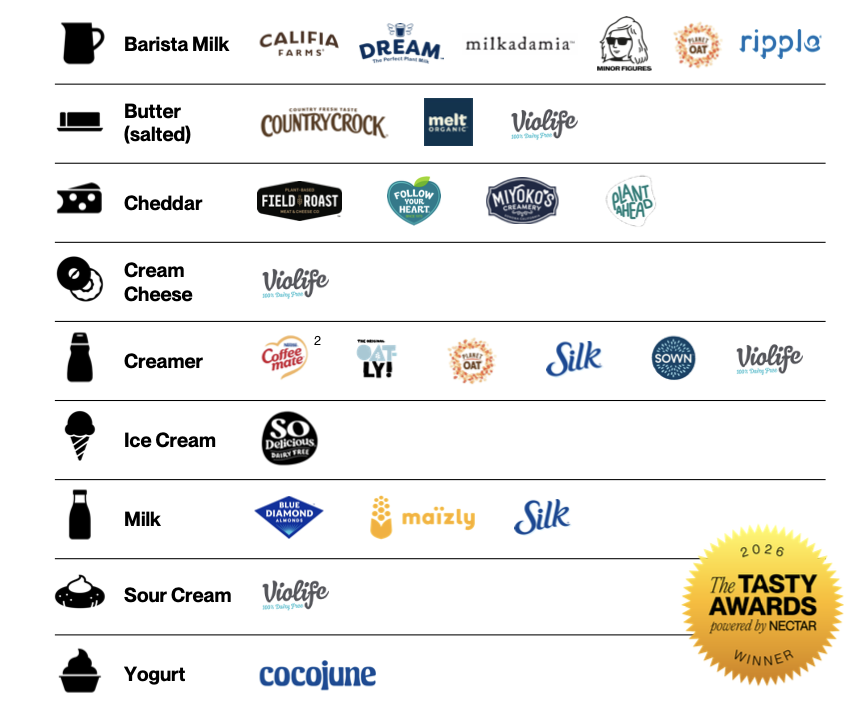
Kenny here. Over the last two decades, the availability of plant-based foods has exploded. You can get a meat-free patty in your Burger King Whopper if that's your thing, buy realistic "chicken" nuggets at your local grocery store, or order marbled plant-based steak from food startups. But one animal-free food category has truly escaped containment from the vegan menu: plant-based milk. Milk made from soybeans, oats, almonds — even corn, bananas, peas, or potatoes — or any other plant-based source now accounts for around 15 percent of fluid milk sales in the US. For comparison, sales of plant-based meat make up around just 1 percent of the American meat market. A new, massive blind taste test might help explain plant-based milk's notable rise: A lot of people just think it tastes good — in some cases, almost as good, or just as good, as cow's milk. (Read on to see which products rose to the top.) Other dairy-free products, like plant-based mozzarella and yogurt? A lot less so, the experiment found. The same goes for most plant-based meats, according to a similar blind taste test I wrote about when it was released last year. Knowing which of these products people like — and dislike — and more importantly, how to make them better, is important, because dairy has a significant environmental footprint. Global dairy production spews about the same amount of climate-warming emissions into the atmosphere as global air travel, and cows' waste is a major source of water pollution. In dairy farming, cows are also subjected to a number of cruel practices, and the industry comes with threats to human workers, as well. A more sustainable and humane future, then, depends on making all dairy alternatives go mainstream, not just your favorite cow-free milk. Results of the big dairy-free blind taste test, explained Late last year, a nonprofit called NECTAR — which researches alternative proteins like plant-based meat and dairy — recruited 2,183 people in San Francisco and New York City to participate in the largest ever blind taste test of dairy-free foods. Six percent of participants were vegetarian, 3 percent were pescatarian, and the rest considered themselves either "flexitarians" or omnivores. Without knowing which version of a product they were tasting, participants tried a number of some of the top-selling 98 plant-based dairy products across 10 categories tested in the experiment, which included ice cream, barista-style milk, yogurt, cream cheese, and regular drinking milk — alongside one animal-based "benchmark" per category for comparison. Each item was prepared as it would be in a real-world setting: cream cheese was smeared on bagels, mozzarella was served on pizzas, creamers were used in coffee, and so on. Participants then rated each product on a seven-point scale — from "dislike very much" to "like very much" — and provided feedback on flavor, texture, and appearance. It might not come as a huge surprise to hear that most participants tended to like conventional dairy products more than plant-based versions. Taking the combined ratings of all products tested, on average, 65 percent of participant ratings on conventional dairy products were "like very much" or "like," while only 35 percent of ratings of the plant-based dairy products reached those levels. The results also highlighted a wide gap in quality among plant-based products. The top dairy-free creamer, sour cream, barista milk, and regular plant-based milk rated at similar levels as the dairy versions. But the averages tended to lag far behind. |
This finding confirms something I've previously written about: There are some very tasty plant-based meat and milk products out there — and a whole lot of not-so-tasty ones. And the latter reality might cause some people to write off whole categories of meat and dairy alternatives after buying and disliking one or two disappointing products. In a head-to-head comparison, only one plant-based product out of the 98 tested achieved "taste parity" with its dairy counterpart: Califia Farms' Oat Barista Blend, which is primarily used in coffee drinks and is meant to replicate something like whole milk. It was tested in lattes against whole cow's milk from Horizon Organic. Participants were split, with 35 percent preferring the oat milk, 35 percent preferring the cow's milk, and 30 percent having no preference between the two. Caroline Cotto, the director of NECTAR, told Vox that Califia Farms achieving taste parity "is really exciting — just to show that this is possible…and [that] this category has legs." Although only one product achieved this vaunted status of taste parity, several others came close. And in other head to head comparisons, 27 percent of the products had at least half of the participants either rate it better than the animal benchmark or had no preference between the two. For context, in NECTAR's blind taste test for plant-based meats released last year, only 16 percent of plant-based meat products reached that bar. "It met my expectations that dairy is a little bit further ahead of where meat alternatives are," Cotto said. |
But it's worth noting that plant-based dairy has an inherent leg up. Many people opt for dairy-free products due to allergies or lactose intolerance, which isn't typically the case with meat. And dairy tends to more often be an ingredient — think milk in coffee, cheese on pizza, sour cream on nachos — rather than the main course, like a steak or sausage. That means how dairy-free products perform on their own matters a bit less than for plant-based meat products. Perhaps the most important finding, in my view, is that, for each dairy-free product — even some of the most poorly rated ones — a good amount of participants enjoyed them. That suggests the market has a lot more potential to grow, and NECTAR has some ideas on how to make that happen. What the dairy-free industry needs to do to level up their products Improving products in the worst-performing categories — like plant-based yogurt and mozzarella — should probably be a top priority for the sector. But every category has room for improvement, NECTAR found. The organization analyzed participants' feedback on flavor, texture, and appearance for each product and found that off flavors and funky aftertastes were a leading complaint, especially for dairy-free yogurt and sour cream. "Increase richness" was the top request for numerous categories, including ice cream, cream cheese, cheddar, and butter. The group shares its results with the companies involved to potentially inform product improvements. "Increase stretchiness" was ranked as a common request for mozzarella, a problem that has long vexed the vegan cheese business. In 2021, I asked in a piece for Vox, "Where's the 'Impossible Burger' of cheese?" As far as I'm aware, it still doesn't exist, though there's buzz around super-stretchy dairy-free mozzarella from the startup Bettani Farms, which launches in restaurants and cafeterias later this year. NECTAR also wants to bring the results to food service operations, like restaurants and university and corporate cafeterias where consumers are usually presented with one unbranded option (like a single oat milk carafe), so they know which products are most popular. But, perhaps, what would be most effective in getting more people to embrace plant-based dairy would be finding ways to lower prices. NECTAR found that, in surveying people, when plant-based milk costs even just 25 percent more than cow's milk, 43 percent fewer people said they would intend to buy it than if it cost the same. And, in the real world, compared to conventional dairy milk, soy and almond milk cost much more. To be sure, people often act differently when shopping. But it does suggest that consumers are price sensitive when swapping dairy products for dairy-free, and other research has borne this out for some milk alternatives. It's worth noting, however, that the low price of cow's milk is somewhat artificial; the US dairy industry is heavily dependent on government support by way of subsidies, environmental and animal welfare deregulation, and federal nutrition policy that all heavily favor conventional dairy over plant-based varieties. While NECTAR's experiment focused on market fundamentals like flavor, texture, and price, there are a number of squishier barriers that stand in the way of widespread plant-based food adoption. Food preferences are shaped not just by our taste buds but also what we ate as children, what our peers like, cultural traditions, and social norms. Addressing those will be just as challenging, if not more so, than improving flavor and price. Plant-based meat and milk alternatives remain one of the more promising avenues available to address our inhumane and environmentally unsustainable factory farming system, though the sector hasn't quite taken off in the way many of its boosters predicted a decade ago. But widespread adoption was never likely to happen overnight. Instead, if it does happen, it'll more likely be a slow, gradual process, with wonky, technical interventions — like food science R&D and blind taste tests — underpinning its success. |
|
|
| Kenny Torrella Senior reporter |
|
|
| Kenny Torrella Senior reporter |
|
|
CAN'T STOP THINKING ABOUT... |
|
|
| Title: Future Perfect fellow
What I cover: Honestly? Things that sound like science fiction.
What I recommend doing if you're in the Chicago area: Go to the Morton Arboretum on one of their Dog Admission Days, whether or not you've got a dog yourself |
|
|
Good news, bad news, but first the bad news: Liz Highleyman's beaten me to the headline "Man Cures Dog?" The good news is that an Australian tech entrepreneur with no biology background was able to use AI to create a customized mRNA vaccine for his dog with a terminal cancer diagnosis. Paul Conyngham rescued Rosie, an 8-year-old mixed breed, in 2019. She was diagnosed with terminal mast cell cancer five years later, and Conyngham spent thousands of dollars on chemotherapy and surgery with little success. So he turned to AI for answers, and ChatGPT suggested immunotherapy. He contacted the Ramaciotti Centre for Genomics at University of New South Wales in Sydney and paid $3,000 to have Rosie's DNA sequenced. "The idea is you take the healthy DNA out of her blood and then you take the DNA out of her tumor, and you sequence both of them to see exactly where the mutations have occurred," Conyngham told the Australian. Once Rosie's DNA was sequenced, he used AlphaFold — Google DeepMind's AI program that predicts protein structure — to model the protein that causes mast cell cancer in dogs. Conyngham then collaborated with the Ramaciotti Centre's director to create a customized mRNA vaccine from Rosie's tumor — and used Grok to design it. It seems to be working, shrinking a tennis ball-sized tumor in half. According to Conyngham, the hardest part was dealing with the red tape. He's now trying to create a second vaccine to shrink a second tumor that didn't respond to the first treatment. None of this work is completely novel — but it's the first time someone has created a customized cancer vaccine for dogs. AI has effectively removed the barrier to entry to tinkering with biology itself, for better and for worse. Not everyone will use the technology to create medical treatments for their best friends. But today, let's focus on the positive. "A lot of people have been asking if this can be done for their dogs and for people," Conyngham wrote on X. "I'm speaking with everyone involved to see what is possible." You can get involved here. |
|
|
The Vox Membership program is getting even better with access to Vox's Patreon, where members can unlock exclusive videos, livestreams, and chats with our newsroom. Become a Vox Member to get access to it all. |
|
|
The battle over what OpenAI owes the public. |
Anna Moneymaker/Getty Images |
Artificial intelligence is transforming work, warfare, and maybe even the way humans think — it's also generating hundreds of billions of dollars for the companies spearheading the upheaval. Chief among those is OpenAI, the company behind ChatGPT (and recent darling of the Pentagon). But there's something odd about this: OpenAI was not always "a company" at all. In 2015, it was founded as a nonprofit to serve the public — to "advance digital intelligence in the way that is most likely to benefit humanity as a whole, unconstrained by a need to generate financial return." Last year, though, OpenAI finalized a split into two interrelated entities: the for-profit OpenAI Group and nonprofit OpenAI Foundation. Since then, OpenAI Group has become one of the world's most valuable private companies — and the foundation has become, on paper at least, one of the largest charities in the world, controlling $180 billion in assets. That amount dwarfs even the Gates Foundation's $77 billion, though OpenAI Foundation's funds, for now, are largely illiquid. Still: How the OpenAI Foundation would choose to spend its fortune — enough to upend the international giving landscape — is a big question mark.
Perhaps one of the biggest questions of them all is: Can the foundation carry out the original OpenAI nonprofit's mission: to make sure that AI is safe and secure technology for everyone? Or will it never do anything to endanger the for-profit company's bottom line? In her new piece, Sara Herschander tells the story of how this split happened, explains the fight over the foundation's future power and funding, and examines the question at the heart of OpenAI's double consciousness: What does OpenAI owe the public? —Seth Maxon, editor
|
|
|
⭐ ONE WAY TO DO GOOD THIS WEEK |
As Vox's resident blood donation evangelist, I am once again asking you to roll up your sleeves and save up to three lives in the process. And if you successfully donate blood, platelets, or plasma this month through the American Red Cross, you can do some good for yourself by getting a free A1C screening, a test showing your blood sugar levels over the past few months. New data from the American Red Cross shows that 1 in 5 blood donors have elevated A1C levels, and 80 percent of donors with those results had readings indicating prediabetes. The good news is that prediabetes is often reversible through lifestyle changes. Prediabetic people typically have a few hundred dollars in extra medical costs compared to their healthy counterparts, but those with blood sugar levels that have progressed to diabetes could incur thousands of dollars more in yearly expenses — 25 times higher than non-diabetic people. Knowing early could save your health and wallet. After successfully donating blood in March, you can access your A1C result within a week or two through the Red Cross Blood Donor App or donor portal at RedCrossBlood.org. You can also check out your other stats like blood pressure, hemoglobin, pulse, and body temperature. It's a good idea to let your health care provider know if you do have elevated A1C levels, but don't let that deter you from future donations: People with prediabetes and diabetes are generally still eligible to give blood if they're otherwise in good health. My sister Maya wrongly convinced herself that she was prediabetic before the complimentary screening gave her peace of mind, so it's win-win no matter your results. —Shayna Korol, Future Perfect fellow |
|
|
Want more Future Perfect in your inbox? Sign up for more newsletters here. Need advice? Submit a question to Sigal Samuel's advice column Your Mileage May Vary. |
|
|
Today's edition was edited by Katherine Courage and Seth Maxon and produced by Seth. We'll see you Friday! |
|
|
|