Meanwhile, fruit flies have shown signs of anhedonia: the loss of interest in previously pleasurable things (like food) that we know as a symptom of depression in humans. Treat the flies with a human antidepressant, and it’ll suppress the depression-like state in the insects, too.
One of my colleagues confessed to me recently that evidence like this makes her feel super guilty. When she goes around killing these insects in her kitchen, she asks herself whether she’s “a fruit-fly Nazi.”
But the key thing to realize is this: Bugs may have some kind of sentience, and sentience may confer some moral status, but that doesn’t mean that provides the last word on how we should act toward them.
Just because another creature might have moral weight, that doesn’t necessarily tell you how to treat that creature when its welfare conflicts with the welfare of a creature you know has moral weight: you.
So, how can you know if or when it’s okay to kill a bug?
I think the most compelling response comes from Elizabeth Anderson, a contemporary philosopher who subscribes to the school of thought known as pragmatism, which sees moral truths as socially embedded and historically contingent, not fixed and objective.
Anderson points out that for most of human history, we couldn’t have survived and thrived without killing or exploiting animals for food, transportation, and their energy. The social conditions for granting animals moral rights didn’t really exist on a mass scale until recently (although some non-Western societies have long ascribed moral worth to animals).
“The possibility of moralizing our relations to animals,” she writes, “has come to us only lately, and even then not to us all, and not with respect to all animal species.”
Anderson has noted that we feel different levels of moral obligation to different species, and that has to do not only with their intrinsic capacities like intelligence or sentience, but also with their relationships to us. It matters whether we’ve made them dependent on us by domesticating them, or whether they live in the wild. It also matters whether they’re fundamentally hostile to us.
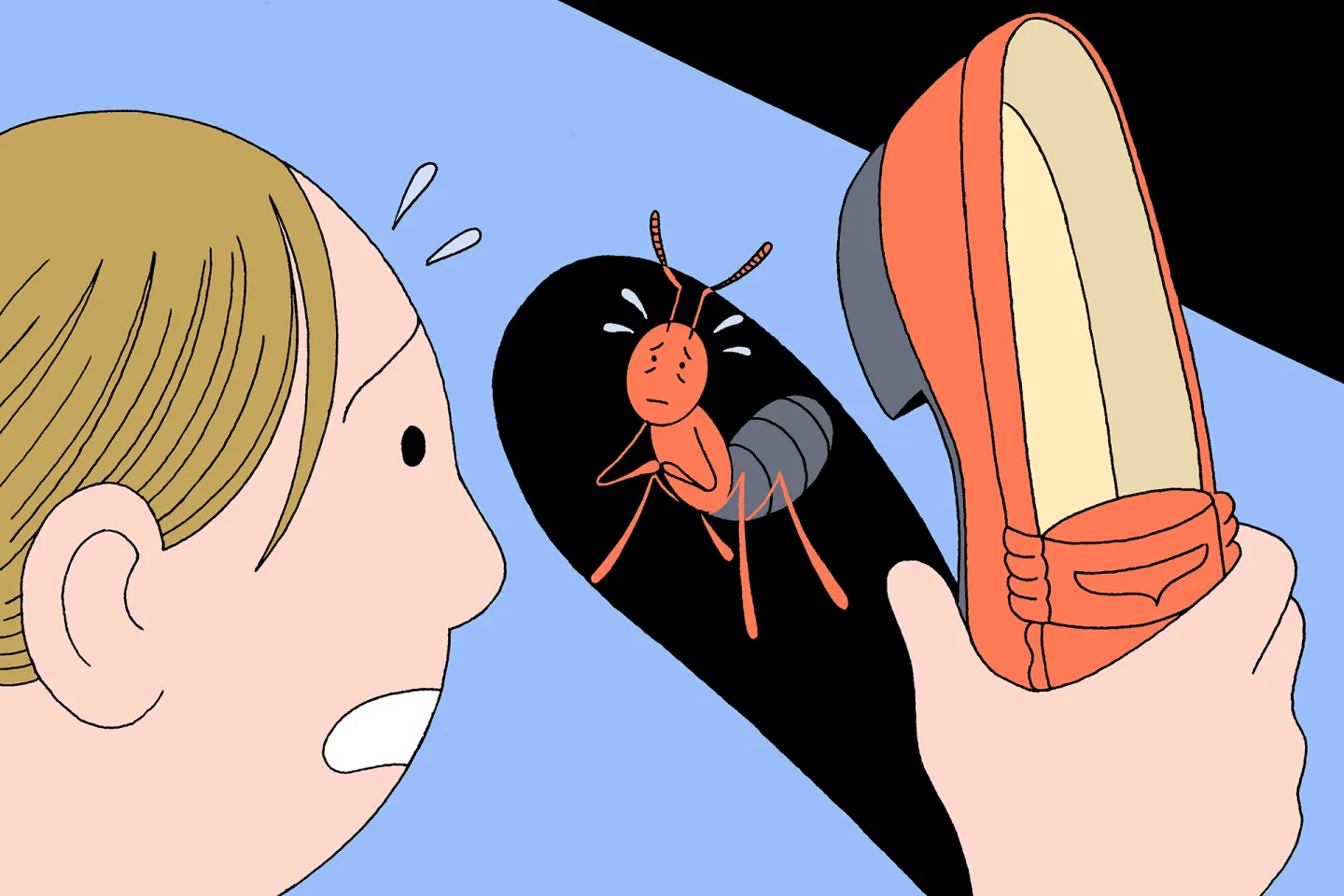
Thinking about pests is a great (if gross) way to bring this point home. If you find bedbugs in your house, nobody expects you to say, “Well, they’re maybe sentient and definitely alive, so they have moral value. I’ll just live and let live!” It is absolutely expected that you will exterminate the shit out of them.
Why? Because with pests, Anderson writes, “there is no possibility of communication, much less compromise. We are in a permanent state of war with them, without possibility of negotiating for peace…Indeed, we have an obligation to our fellow members of society (whether human or animal) to drive them out, whenever this is necessary to protect ourselves.”
Anderson’s point is not that sentience doesn’t matter. It’s that lots of other things matter, too, including our own ability to thrive.
Embracing this value pluralism makes things tricky. It suggests that the best we can do is look at creatures’ intelligence and sentience and relationships to us as clues about how we should negotiate life with (or without) them. But it doesn’t tell us how to weigh those clues — and what to do when they conflict with the interests of other animals, including us.
“There’s no simple formula,” Anderson once told me. “I think that’s a hopeless quest.”
That is, for my money, the most intellectually honest position. The absence of a fixed formula doesn’t mean you should exist in a state of guilty indecision or paralysis. Instead, the best thing you can do is have the integrity to recognize that sometimes life presents you with trade-offs where you have to make a choice. And when it comes to insects, you’re making that choice from a position of considerable power.
This is the conclusion Robin Wall Kimmerer reaches in her book Braiding Sweetgrass: Indigenous Wisdom, Scientific Knowledge, and the Teachings of Plants. The scientist describes how she had an algae-filled pond in her yard that she wanted to clear out so her daughters could swim in it. As a member of the Citizen Potawatomi Nation, though, she believes that all life has moral worth. So as she raked out the muck and found that it was full of tadpoles, she plucked them all out so they could go on living. Then she inspected the pond water under her microscope and saw a ton of teensy organisms, each one a moral dilemma. She writes:
As I raked and plucked, it challenged my conviction that all lives are valuable, protozoan or not. As a theoretical matter, I hold this to be true, but on a practical level it gets murky, the spiritual and the pragmatic bumping heads. With every rake I knew that I was prioritizing. Short, single-cell lives were ended because I wanted a clear pond. I’m bigger, I have a rake, so I win. That’s not a worldview I readily endorse.
But it didn’t keep me awake at night, or halt my efforts; I simply acknowledged the choices I was making. The best I could do was to be respectful and not let the small lives go to waste. I plucked out whatever wee beasties I could and the rest went into the compost pile, to start the cycle again as soil.
In a way, it’s an unsatisfying solution — a lot of us would probably sleep easier if nature came inscribed with clear bright lines and moral instructions. But there you have it. Like Kimmerer, I think you should practice a kind of harm reduction. To the extent that you can “live and let live” with insects, that’s ideal. Try to minimize how many you kill. But when you do make the choice to kill them, try to do it in a way that reduces the risk of suffering (think: quick and painless crushing rather than long and drawn-out poisoning).
That’s not only for the bug’s benefit, but for yours, too. Harming any animal can harm our character if we do it mindlessly or callously, because it desensitizes us to life. But when we let ourselves be touched by life, we can maintain our reverence for it. The reverence — not the guilt — is the thing you want to hold onto.